
Desktop Dual-Axis Belt Sander: A 750W Sharpening and Polishing Tool with 1000-7000 RPM Variable Speed Control for Precision Work
Blue / 110V US
£243.98
Sale price
£243.98
Regular price
Skip to product information

 This desktop belt sander is built for the workshop enthusiast or hobbyist needing a dedicated station for finishing and sharpening. Its 750W motor delivers consistent power for working with wood, plastics, and soft metals, while the key feature is the variable speed control. A continuously variable transmission switch lets you dial in the belt speed from 1000 to 7000 RPM, giving you command over the aggressiveness of the cut or the finesse of the polish. The machine uses commonly available 40mm by 680mm abrasive belts and its dual-axis design provides two accessible sanding surfaces to tackle edges and contours from different angles.
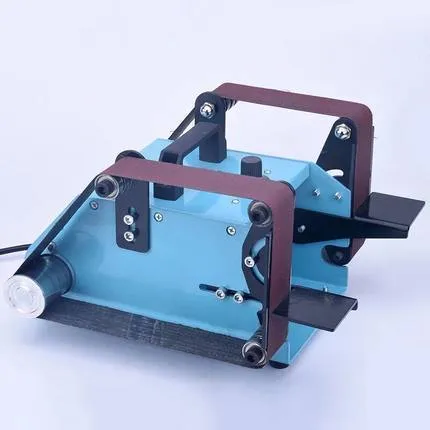 This sander is designed as a permanent bench-top fixture, with its functionality centred on control and accessibility. The following sections detail the specific design choices, technical specifications, and construction elements that define its performance and durability for workshop tasks.
 Owning a dedicated bench sander moves specific tasks away from less suitable tools like angle grinders or handheld sanders. The benefits are measured in time saved, improved finish quality, and the longevity of your other tools. Here’s how the investment translates into practical workshop value.


Desktop Dual-Axis Belt Sander: A 750W Sharpening and Polishing Tool with 1000-7000 RPM Variable Speed Control for Precision Work
£243.98
Sale price
£243.98
Regular price
Desktop Dual-Axis Belt Sander: 750W Variable Speed Tool for Sharpening and Polishing
Features and Build Quality of the Bench Sander
Compact Bench-Top Design and Dimensions
With overall dimensions of 310mm in length, 250mm in width, and 190mm in height, this sander has a footprint smaller than an A3 sheet of paper, making it suitable for workshops where space is at a premium. The blue-coated steel housing provides a stable base that resists vibration during operation. This fixed position allows for two-handed control of the workpiece, which is crucial for maintaining consistent angles during tool sharpening or achieving even finishes on sanded edges.Motor Power and Speed Specifications
Durability and Component ConstructionPractical Applications for the Dual-Axis Sander This isn't a tool for on-site construction, but a focused asset for detailed making and maintenance. Its applications span from professional prototyping to weekend DIY projects, where precision and finish are more important than portability. Below are specific scenarios where its features provide a tangible advantage.Professional and Workshop Use
In a small professional workshop, such as a knife maker's studio or a luthier's bench, this sander accelerates repetitive tasks. The dual axes allow a blade to be presented to the belt at a fixed angle for consistent bevel grinding, then flipped to the other axis for refining the edge. For a furniture restorer, the variable speed is key; a low RPM with a fine-grit belt can carefully remove old varnish from a curved chair leg without damaging the wood underneath, something a fixed-speed sander could easily scorch.Everyday Hobbyist and DIY Use
For the home hobbyist, it brings industrial control to the garden shed. The feeling of pushing a wooden knife handle blank against the 40mm wide belt at a medium speed provides a smooth, controlled removal of material, with the machine's hum remaining steady thanks to the 750W power reserve. When sharpening garden shears, the ability to hold the tool securely with both hands and glide the edge along the belt at a slow speed creates a sharp, even bevel with minimal risk of nicking the blade—a tactile and visual confirmation of the tool's precision.Versatility Across Materials and Tasks
Its versatility lies in the combination of adjustable speed and standard belt availability. One morning it could be shaping a hardwood dowel for a project (using a 60-grit belt at 5000 RPM), and in the afternoon, it could be polishing a forged copper pendant (using a 400-grit belt at 2000 RPM). The dual-axis setup adds to this; one belt can be kept with a coarse grit for shaping, while the other axis holds a finer grit for finishing, allowing you to switch tasks without stopping to change the abrasive.Tangible Benefits and Long-Term Value
Cost-Efficiency and Tool Longevity
User Confidence and Result ConsistencyA Call for Precision in Your Workspace If your projects involve any regular sharpening, shaping, or finishing of small to medium items, this sander creates a dedicated, efficient station. The measurable benefit is the reduction in time and effort to achieve a professional standard finish. By providing 750W of power and full control over speed from 1000 to 7000 RPM, it allows you to execute a wide range of tasks from aggressive shaping to delicate polishing, making it a core tool for anyone serious about precision craftwork.